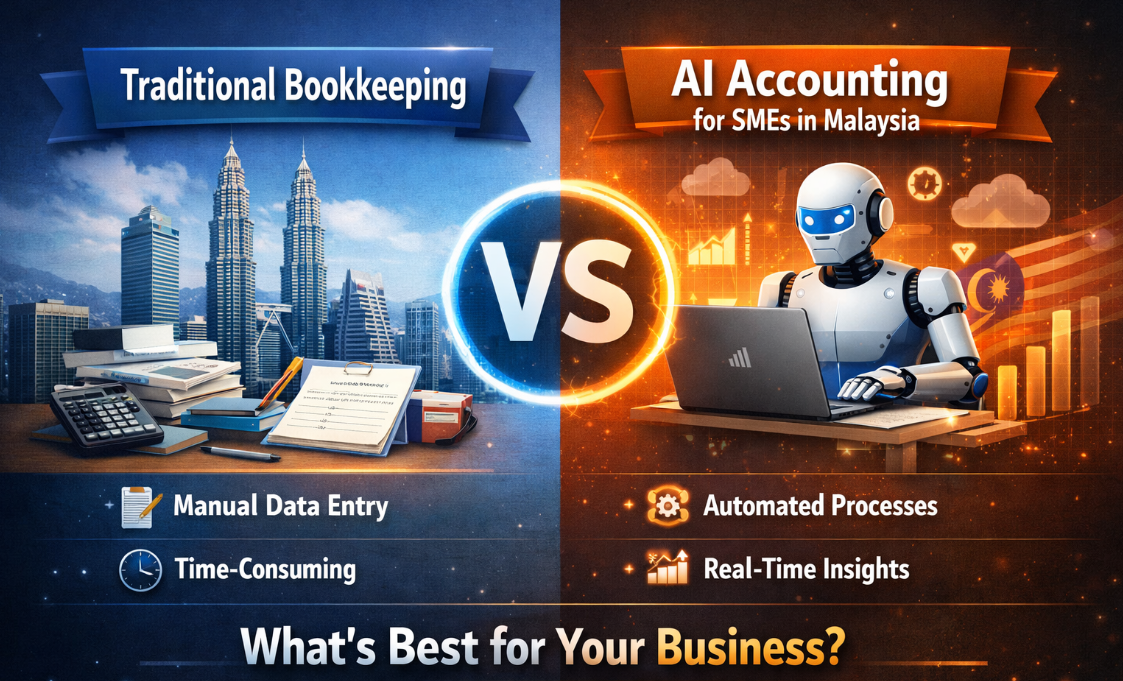
Traditional Bookkeeping vs AI Accounting for SMEs in Malaysia: What’s Best for Your Business?
Introduction
Managing finances is one of the most critical aspects of running a successful SME in Malaysia. From tracking expenses to ensuring compliance with LHDN and SST regulations, business owners need reliable systems to stay in control.
For decades, traditional bookkeeping has been the standard. But with rapid digital transformation, AI accounting tools are changing how Malaysian SMEs handle their finances.
So which is better for your business in 2026?
Let’s break it down.
What is Traditional Bookkeeping?
Traditional bookkeeping refers to manually recording financial transactions using spreadsheets, ledgers, or basic accounting software.
Key Features:
Manual data entry
Periodic financial updates such as weekly or monthly
Heavy reliance on human accuracy
Often handled by in house staff or external accountants
Pros:
Familiar and widely used
Low initial cost
Full control over records
Cons:
Time consuming
Prone to human error
Delayed financial insights
Limited scalability
For many Malaysian SMEs, especially smaller or family run businesses, this method is still common. However, as businesses grow, the limitations become more obvious.
What is AI Accounting?
AI accounting uses artificial intelligence to automate financial tasks such as data entry, categorisation, reconciliation, and reporting.
Modern AI tools can:
Automatically capture receipts and invoices
Categorise expenses in real time
Generate financial reports instantly
Provide insights and predictions
Key Features:
Automation of repetitive tasks
Real time financial tracking
Intelligent data analysis
Cloud based accessibility
Pros:
Saves time and reduces workload
Minimises human errors
Provides real time insights
Scales easily with your business
Cons:
Initial learning curve
Subscription based cost
Requires internet access
Traditional Bookkeeping vs AI Accounting A Side by Side Comparison
| Feature | Traditional Bookkeeping | AI Accounting |
| Data Entry | Manual | Automated |
| Accuracy | Moderate with risk of human error | High with AI support |
| Speed | Slow | Real time |
| Insights | Limited | Advanced analytics |
| Cost | Lower upfront | Subscription based |
| Scalability | Limited | Highly scalable |
Why Malaysian SMEs Are Shifting Towards AI Accounting
In Malaysia’s fast moving business environment, speed and accuracy are becoming competitive advantages.
Here’s why more SMEs are making the switch:
1. Compliance with Malaysian Regulations
AI accounting tools like Teera.AI can help ensure your records are organised for LHDN submissions and SST reporting, reducing stress during tax season.
2. Better Cash Flow Management
Real time tracking allows business owners to monitor incoming and outgoing cash instantly which is critical for SMEs operating on tight margins.
3. Time Savings
Instead of spending hours on bookkeeping, business owners can focus on growth, sales, and operations.
4. Data Driven Decisions
AI accounting tools like Teera.AI do not just store data they analyse it helping SMEs make smarter financial decisions.
When Traditional Bookkeeping Still Makes Sense
Despite the advantages of AI, traditional bookkeeping may still work if:
Your business is very small with minimal transactions
You prefer full manual control
You are not yet ready to adopt new technology .However, even in these cases, transitioning gradually to digital solutions can provide long term benefits.
The Hybrid Approach The Best of Both Worlds
Some SMEs in Malaysia are adopting a hybrid approach combining human expertise with AI automation.
This allows:
Accountants to focus on strategy rather than data entry
Business owners to access real time insights
Reduced operational costs over time
This is where advanced AI Accounting platforms like Teera.AI powered accounting systems are gaining attention bridging the gap between traditional methods and intelligent automation.
What Should You Choose for Your SME
The right choice depends on your business stage and goals.
Choose Traditional Bookkeeping if:
You have very simple financial needs
Budget is extremely tight
You are comfortable managing everything manually
Choose AI Accounting if:
You want to save time and reduce errors
You need real time financial visibility
You plan to scale your business
You want smarter insights not just records
A Smarter Direction for Malaysian SMEs
As Malaysia moves towards a more digital economy, SMEs that adopt smarter tools will have a clear advantage.
AI accounting is no longer just for large corporations, it is becoming accessible, practical and highly valuable for everyday businesses.
Solutions like TEERA.AI are designed specifically with SMEs in mind helping reduce stress, improve productivity and give business owners more control over their finances without the usual complexity.
Frequently Asked Questions FAQs
1. Is AI accounting suitable for small businesses in Malaysia
Yes, AI accounting tools like Teera.AI are increasingly designed for SMEs offering affordable plans and user-friendly interfaces tailored to local business needs.
2. Will AI replace accountants
No AI enhances accountants roles by automating repetitive tasks allowing them to focus on advisory and strategic work.
3. Is Teera. AI accounting compliant with LHDN requirements
The Teera.AI accounting system is built to align with Malaysian compliance standards but it is always important to ensure proper configuration and usage.
4. How much does AI accounting cost in Malaysia
Costs vary depending on features and providers but many platforms offer scalable pricing suitable for SMEs.
5. Can I switch from traditional bookkeeping to Teera.AI accounting easily
Yes, the Teera.AI accounting platform provides onboarding support and data migration tools to make the transition smooth.
Final Thoughts
Traditional bookkeeping has served SMEs well for decades but the demands of modern business require faster, smarter and more efficient solutions.
AI accounting is not just a trend it is a shift in how businesses operate.
For Malaysian SMEs looking to grow, reduce stress and improve financial clarity, adopting AI driven tools like Teera.AI may not just be an option, it could be the competitive edge that defines the future.