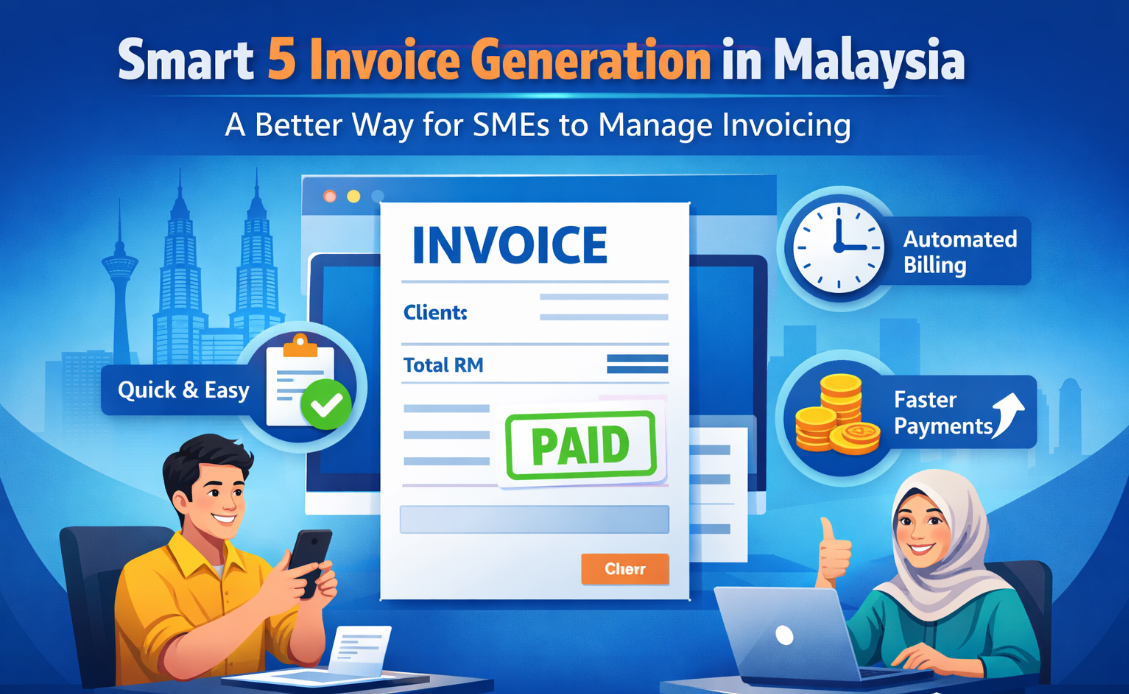
Smart 5 Invoice Generation in Malaysia with TEERA.AI A Better Way for SMEs to Manage Invoicing
Introduction
For many small and medium sized enterprises SMEs in Malaysia, invoicing is a necessary but time consuming task. Manually creating invoices, tracking payments, and following up with customers often takes up valuable time that could be better spent on growing the business.
This is where smart invoice generation comes in.
With smart AI powered tools like TEERA.AI, Malaysian SMEs can automate invoicing, reduce errors, and gain better visibility over their cash flow all in one system.
What Is Smart Invoice Generation
Smart invoice generation refers to the use of AI and automation to create, send, and manage invoices efficiently.
Instead of manually handling every step, a producitivity system like TEERA.AI allows businesses to:
- Generate invoices automatically
- Maintain accurate records
- Track payments in real time
- Reduce repetitive administrative work
In simple terms, it transforms invoicing from a manual task into an automated intelligent process.
Why Smart Invoice Generation Matters for SMEs in Malaysia
Many SMEs in Malaysia still rely on spreadsheets, manual templates, or basic accounting methods for invoicing. This often leads to:
- Delayed invoice issuance
- Human errors in calculations
- Difficulty tracking unpaid invoices
- Poor cash flow visibility
- Increased administrative workload
Using smart invoicing through TEERA.AI helps solve these challenges by centralising and automating the entire invoicing workflow.
Key Features of Smart Invoice Generation with TEERA.AI
1 Automated Invoice Creation
With TEERA.AI, invoices can be generated quickly based on:
- Customer information
- Services or products provided
- Pre set pricing and templates
This eliminates the need for repetitive manual data entry.
2 Accurate and Error Free Invoicing
Automation reduces common mistakes such as:
- Incorrect totals
- Missing details
- Duplicate entries
This ensures invoices remain consistent, accurate, and professional.
3 Real Time Invoice Tracking
One of the key advantages of TEERA.AI is the ability to monitor invoice status in real time:
- Sent invoices
- Viewed invoices
- Paid and unpaid invoices
- Overdue payments
This gives business owners full visibility over receivables.
4 Payment Monitoring and Follow Ups
Instead of manually checking bank statements or spreadsheets, SMEs can:
- Identify overdue invoices quickly
- Track outstanding payments
- Follow up with customers more efficiently
This helps improve collection processes and reduces delays.
5 Centralised Financial Records
All invoices are stored within the system, making it easier to:
- Access historical records
- Generate financial summaries
- Prepare documentation for audits or compliance with LHDN
Benefits of Using TEERA.AI for Smart Invoice Generation
Improved Cash Flow
Faster invoicing leads to faster payments. With TEERA.AI, SMEs can issue invoices promptly and track payments efficiently, helping improve overall cash flow.
Better Organisation
Invoices are systematically recorded and easy to retrieve, eliminating the need for scattered files or spreadsheets.
Increased Professionalism
Consistent, well structured invoices help businesses present a more professional image to clients.
Smarter Financial Decision Making
With real time data provided by TEERA.AI, business owners gain better insights into revenue, outstanding payments, and financial performance.
Smart Invoice Generation vs Manual Invoicing
| Aspect | Manual Invoicing | Smart Invoice Generation with TEERA.AI |
| Speed | Time consuming | Fast and automated |
| Accuracy | Prone to human error | Highly accurate |
| Tracking | Difficult | Real time tracking |
| Effort | High manual effort | Minimal effort |
| Scalability | Limited | Easily scalable |
Who Should Use Smart Invoice Generation
Smart invoicing is ideal for:
- Service based SMEs in Malaysia
- Freelancers and consultants
- Retail and e commerce businesses
- Contractors and project based companies
- Growing businesses managing multiple clients
If your business handles frequent invoicing, adopting a system like TEERA.AI can significantly improve efficiency.
Frequently Asked Questions
What is smart invoice generation
Smart invoice generation is the use of AI and automation to create, send, and manage invoices efficiently without manual effort.
How does TEERA.AI help with invoicing
TEERA.AI helps SMEs automate invoice creation, track payments in real time, and maintain organised financial records in one platform.
Is smart invoicing useful for small businesses in Malaysia
Yes. Small businesses benefit from automation as it reduces manual work, improves accuracy, and helps manage cash flow more effectively.
Can smart invoicing improve cash flow
Yes. By speeding up invoice creation and improving payment tracking, businesses can receive payments faster and manage cash flow more efficiently.
Final Thoughts
Invoicing is more than just billing. It is a critical part of cash flow management and financial control.
For Malaysian SMEs, adopting smart invoice generation through TEERA.AI is a practical step toward:
- Reducing manual work
- Improving accuracy
- Enhancing cash flow visibility
- Scaling operations efficiently
As businesses grow, having the right invoicing system is no longer optional. It becomes essential for sustainable success.
- Table of Contents
- Introduction
- Key Features of Smart Invoice Generation with TEERA.AI
-
- Centralised Financial Records
-
- Who Should Use Smart Invoice Generation
- Frequently Asked Questions
- Final Thoughts
Introduction
For many small and medium sized enterprises SMEs in Malaysia, invoicing is a necessary but time consuming task. Manually creating invoices, tracking payments, and following up with customers often takes up valuable time that could be better spent on growing the business.
This is where smart invoice generation comes in.
With smart AI powered tools like TEERA.AI, Malaysian SMEs can automate invoicing, reduce errors, and gain better visibility over their cash flow all in one system.
What Is Smart Invoice Generation
Smart invoice generation refers to the use of AI and automation to create, send, and manage invoices efficiently.
Instead of manually handling every step, a producitivity system like TEERA.AI allows businesses to:
- Generate invoices automatically
- Maintain accurate records
- Track payments in real time
- Reduce repetitive administrative work
In simple terms, it transforms invoicing from a manual task into an automated intelligent process.
Why Smart Invoice Generation Matters for SMEs in Malaysia
Many SMEs in Malaysia still rely on spreadsheets, manual templates, or basic accounting methods for invoicing. This often leads to:
- Delayed invoice issuance
- Human errors in calculations
- Difficulty tracking unpaid invoices
- Poor cash flow visibility
- Increased administrative workload
Using smart invoicing through TEERA.AI helps solve these challenges by centralising and automating the entire invoicing workflow.
Key Features of Smart Invoice Generation with TEERA.AI
1 Automated Invoice Creation
With TEERA.AI, invoices can be generated quickly based on:
- Customer information
- Services or products provided
- Pre set pricing and templates
This eliminates the need for repetitive manual data entry.
2 Accurate and Error Free Invoicing
Automation reduces common mistakes such as:
- Incorrect totals
- Missing details
- Duplicate entries
This ensures invoices remain consistent, accurate, and professional.
3 Real Time Invoice Tracking
One of the key advantages of TEERA.AI is the ability to monitor invoice status in real time:
- Sent invoices
- Viewed invoices
- Paid and unpaid invoices
- Overdue payments
This gives business owners full visibility over receivables.
4 Payment Monitoring and Follow Ups
Instead of manually checking bank statements or spreadsheets, SMEs can:
- Identify overdue invoices quickly
- Track outstanding payments
- Follow up with customers more efficiently
This helps improve collection processes and reduces delays.
5 Centralised Financial Records
All invoices are stored within the system, making it easier to:
- Access historical records
- Generate financial summaries
- Prepare documentation for audits or compliance with LHDN
Benefits of Using TEERA.AI for Smart Invoice Generation
Improved Cash Flow
Faster invoicing leads to faster payments. With TEERA.AI, SMEs can issue invoices promptly and track payments efficiently, helping improve overall cash flow.
Better Organisation
Invoices are systematically recorded and easy to retrieve, eliminating the need for scattered files or spreadsheets.
Increased Professionalism
Consistent, well structured invoices help businesses present a more professional image to clients.
Smarter Financial Decision Making
With real time data provided by TEERA.AI, business owners gain better insights into revenue, outstanding payments, and financial performance.
Smart Invoice Generation vs Manual Invoicing
| Aspect | Manual Invoicing | Smart Invoice Generation with TEERA.AI |
| Speed | Time consuming | Fast and automated |
| Accuracy | Prone to human error | Highly accurate |
| Tracking | Difficult | Real time tracking |
| Effort | High manual effort | Minimal effort |
| Scalability | Limited | Easily scalable |
Who Should Use Smart Invoice Generation
Smart invoicing is ideal for:
- Service based SMEs in Malaysia
- Freelancers and consultants
- Retail and e commerce businesses
- Contractors and project based companies
- Growing businesses managing multiple clients
If your business handles frequent invoicing, adopting a system like TEERA.AI can significantly improve efficiency.
Frequently Asked Questions
What is smart invoice generation
Smart invoice generation is the use of AI and automation to create, send, and manage invoices efficiently without manual effort.
How does TEERA.AI help with invoicing
TEERA.AI helps SMEs automate invoice creation, track payments in real time, and maintain organised financial records in one platform.
Is smart invoicing useful for small businesses in Malaysia
Yes. Small businesses benefit from automation as it reduces manual work, improves accuracy, and helps manage cash flow more effectively.
Can smart invoicing improve cash flow
Yes. By speeding up invoice creation and improving payment tracking, businesses can receive payments faster and manage cash flow more efficiently.
Final Thoughts
Invoicing is more than just billing. It is a critical part of cash flow management and financial control.
For Malaysian SMEs, adopting smart invoice generation through TEERA.AI is a practical step toward:
- Reducing manual work
- Improving accuracy
- Enhancing cash flow visibility
- Scaling operations efficiently
As businesses grow, having the right invoicing system is no longer optional. It becomes essential for sustainable success.
- Table of Contents
- Introduction
- Key Features of Smart Invoice Generation with TEERA.AI
-
- Centralised Financial Records
-
- Who Should Use Smart Invoice Generation
- Frequently Asked Questions
- Final Thoughts
Introduction
For many small and medium sized enterprises SMEs in Malaysia, invoicing is a necessary but time consuming task. Manually creating invoices, tracking payments, and following up with customers often takes up valuable time that could be better spent on growing the business.
This is where smart invoice generation comes in.
With smart AI powered tools like TEERA.AI, Malaysian SMEs can automate invoicing, reduce errors, and gain better visibility over their cash flow all in one system.
What Is Smart Invoice Generation
Smart invoice generation refers to the use of AI and automation to create, send, and manage invoices efficiently.
Instead of manually handling every step, a producitivity system like TEERA.AI allows businesses to:
- Generate invoices automatically
- Maintain accurate records
- Track payments in real time
- Reduce repetitive administrative work
In simple terms, it transforms invoicing from a manual task into an automated intelligent process.
Why Smart Invoice Generation Matters for SMEs in Malaysia
Many SMEs in Malaysia still rely on spreadsheets, manual templates, or basic accounting methods for invoicing. This often leads to:
- Delayed invoice issuance
- Human errors in calculations
- Difficulty tracking unpaid invoices
- Poor cash flow visibility
- Increased administrative workload
Using smart invoicing through TEERA.AI helps solve these challenges by centralising and automating the entire invoicing workflow.
Key Features of Smart Invoice Generation with TEERA.AI
1 Automated Invoice Creation
With TEERA.AI, invoices can be generated quickly based on:
- Customer information
- Services or products provided
- Pre set pricing and templates
This eliminates the need for repetitive manual data entry.
2 Accurate and Error Free Invoicing
Automation reduces common mistakes such as:
- Incorrect totals
- Missing details
- Duplicate entries
This ensures invoices remain consistent, accurate, and professional.
3 Real Time Invoice Tracking
One of the key advantages of TEERA.AI is the ability to monitor invoice status in real time:
- Sent invoices
- Viewed invoices
- Paid and unpaid invoices
- Overdue payments
This gives business owners full visibility over receivables.
4 Payment Monitoring and Follow Ups
Instead of manually checking bank statements or spreadsheets, SMEs can:
- Identify overdue invoices quickly
- Track outstanding payments
- Follow up with customers more efficiently
This helps improve collection processes and reduces delays.
5 Centralised Financial Records
All invoices are stored within the system, making it easier to:
- Access historical records
- Generate financial summaries
- Prepare documentation for audits or compliance with LHDN
Benefits of Using TEERA.AI for Smart Invoice Generation
Improved Cash Flow
Faster invoicing leads to faster payments. With TEERA.AI, SMEs can issue invoices promptly and track payments efficiently, helping improve overall cash flow.
Better Organisation
Invoices are systematically recorded and easy to retrieve, eliminating the need for scattered files or spreadsheets.
Increased Professionalism
Consistent, well structured invoices help businesses present a more professional image to clients.
Smarter Financial Decision Making
With real time data provided by TEERA.AI, business owners gain better insights into revenue, outstanding payments, and financial performance.
Smart Invoice Generation vs Manual Invoicing
| Aspect | Manual Invoicing | Smart Invoice Generation with TEERA.AI |
| Speed | Time consuming | Fast and automated |
| Accuracy | Prone to human error | Highly accurate |
| Tracking | Difficult | Real time tracking |
| Effort | High manual effort | Minimal effort |
| Scalability | Limited | Easily scalable |
Who Should Use Smart Invoice Generation
Smart invoicing is ideal for:
- Service based SMEs in Malaysia
- Freelancers and consultants
- Retail and e commerce businesses
- Contractors and project based companies
- Growing businesses managing multiple clients
If your business handles frequent invoicing, adopting a system like TEERA.AI can significantly improve efficiency.
Frequently Asked Questions
What is smart invoice generation
Smart invoice generation is the use of AI and automation to create, send, and manage invoices efficiently without manual effort.
How does TEERA.AI help with invoicing
TEERA.AI helps SMEs automate invoice creation, track payments in real time, and maintain organised financial records in one platform.
Is smart invoicing useful for small businesses in Malaysia
Yes. Small businesses benefit from automation as it reduces manual work, improves accuracy, and helps manage cash flow more effectively.
Can smart invoicing improve cash flow
Yes. By speeding up invoice creation and improving payment tracking, businesses can receive payments faster and manage cash flow more efficiently.
Final Thoughts
Invoicing is more than just billing. It is a critical part of cash flow management and financial control.
For Malaysian SMEs, adopting smart invoice generation through TEERA.AI is a practical step toward:
- Reducing manual work
- Improving accuracy
- Enhancing cash flow visibility
- Scaling operations efficiently
As businesses grow, having the right invoicing system is no longer optional. It becomes essential for sustainable success.
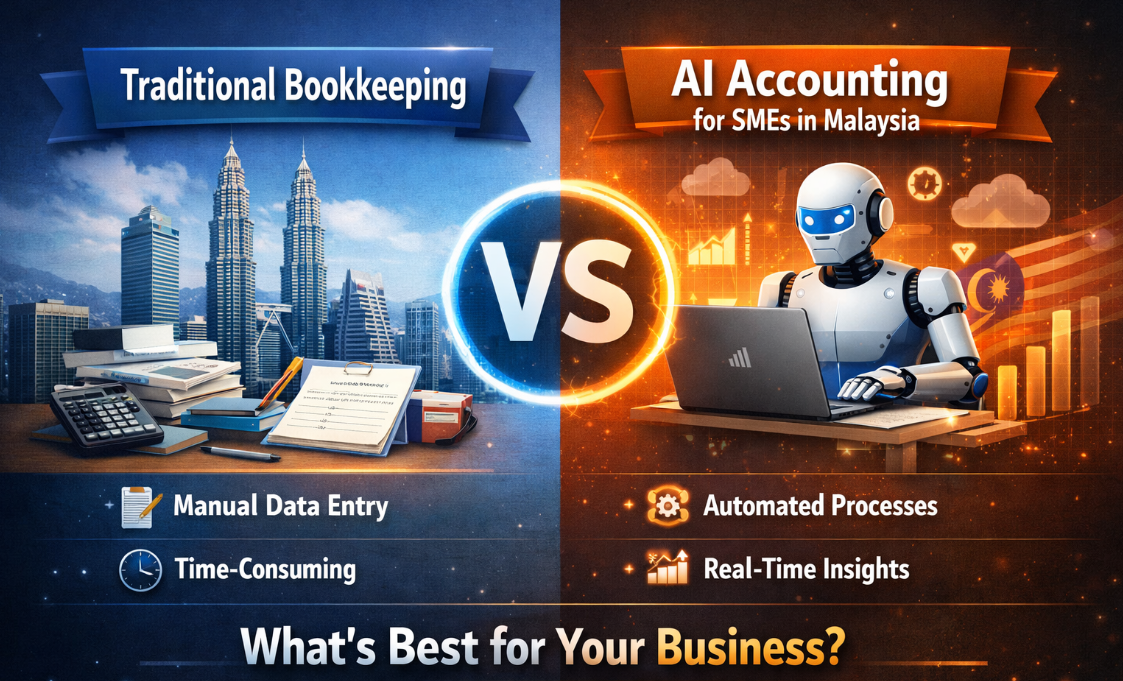
Traditional Bookkeeping vs AI Accounting for SMEs in Malaysia: What’s Best for Your Business?
Introduction
Managing finances is one of the most critical aspects of running a successful SME in Malaysia. From tracking expenses to ensuring compliance with LHDN and SST regulations, business owners need reliable systems to stay in control.
For decades, traditional bookkeeping has been the standard. But with rapid digital transformation, AI accounting tools are changing how Malaysian SMEs handle their finances.
So which is better for your business in 2026?
Let’s break it down.
What is Traditional Bookkeeping?
Traditional bookkeeping refers to manually recording financial transactions using spreadsheets, ledgers, or basic accounting software.
Key Features:
Manual data entry
Periodic financial updates such as weekly or monthly
Heavy reliance on human accuracy
Often handled by in house staff or external accountants
Pros:
Familiar and widely used
Low initial cost
Full control over records
Cons:
Time consuming
Prone to human error
Delayed financial insights
Limited scalability
For many Malaysian SMEs, especially smaller or family run businesses, this method is still common. However, as businesses grow, the limitations become more obvious.
What is AI Accounting?
AI accounting uses artificial intelligence to automate financial tasks such as data entry, categorisation, reconciliation, and reporting.
Modern AI tools can:
Automatically capture receipts and invoices
Categorise expenses in real time
Generate financial reports instantly
Provide insights and predictions
Key Features:
Automation of repetitive tasks
Real time financial tracking
Intelligent data analysis
Cloud based accessibility
Pros:
Saves time and reduces workload
Minimises human errors
Provides real time insights
Scales easily with your business
Cons:
Initial learning curve
Subscription based cost
Requires internet access
Traditional Bookkeeping vs AI Accounting A Side by Side Comparison
| Feature | Traditional Bookkeeping | AI Accounting |
| Data Entry | Manual | Automated |
| Accuracy | Moderate with risk of human error | High with AI support |
| Speed | Slow | Real time |
| Insights | Limited | Advanced analytics |
| Cost | Lower upfront | Subscription based |
| Scalability | Limited | Highly scalable |
Why Malaysian SMEs Are Shifting Towards AI Accounting
In Malaysia’s fast moving business environment, speed and accuracy are becoming competitive advantages.
Here’s why more SMEs are making the switch:
1. Compliance with Malaysian Regulations
AI accounting tools like Teera.AI can help ensure your records are organised for LHDN submissions and SST reporting, reducing stress during tax season.
2. Better Cash Flow Management
Real time tracking allows business owners to monitor incoming and outgoing cash instantly which is critical for SMEs operating on tight margins.
3. Time Savings
Instead of spending hours on bookkeeping, business owners can focus on growth, sales, and operations.
4. Data Driven Decisions
AI accounting tools like Teera.AI do not just store data they analyse it helping SMEs make smarter financial decisions.
When Traditional Bookkeeping Still Makes Sense
Despite the advantages of AI, traditional bookkeeping may still work if:
Your business is very small with minimal transactions
You prefer full manual control
You are not yet ready to adopt new technology .However, even in these cases, transitioning gradually to digital solutions can provide long term benefits.
The Hybrid Approach The Best of Both Worlds
Some SMEs in Malaysia are adopting a hybrid approach combining human expertise with AI automation.
This allows:
Accountants to focus on strategy rather than data entry
Business owners to access real time insights
Reduced operational costs over time
This is where advanced AI Accounting platforms like Teera.AI powered accounting systems are gaining attention bridging the gap between traditional methods and intelligent automation.
What Should You Choose for Your SME
The right choice depends on your business stage and goals.
Choose Traditional Bookkeeping if:
You have very simple financial needs
Budget is extremely tight
You are comfortable managing everything manually
Choose AI Accounting if:
You want to save time and reduce errors
You need real time financial visibility
You plan to scale your business
You want smarter insights not just records
A Smarter Direction for Malaysian SMEs
As Malaysia moves towards a more digital economy, SMEs that adopt smarter tools will have a clear advantage.
AI accounting is no longer just for large corporations, it is becoming accessible, practical and highly valuable for everyday businesses.
Solutions like TEERA.AI are designed specifically with SMEs in mind helping reduce stress, improve productivity and give business owners more control over their finances without the usual complexity.
Frequently Asked Questions FAQs
1. Is AI accounting suitable for small businesses in Malaysia
Yes, AI accounting tools like Teera.AI are increasingly designed for SMEs offering affordable plans and user-friendly interfaces tailored to local business needs.
2. Will AI replace accountants
No AI enhances accountants roles by automating repetitive tasks allowing them to focus on advisory and strategic work.
3. Is Teera. AI accounting compliant with LHDN requirements
The Teera.AI accounting system is built to align with Malaysian compliance standards but it is always important to ensure proper configuration and usage.
4. How much does AI accounting cost in Malaysia
Costs vary depending on features and providers but many platforms offer scalable pricing suitable for SMEs.
5. Can I switch from traditional bookkeeping to Teera.AI accounting easily
Yes, the Teera.AI accounting platform provides onboarding support and data migration tools to make the transition smooth.
Final Thoughts
Traditional bookkeeping has served SMEs well for decades but the demands of modern business require faster, smarter and more efficient solutions.
AI accounting is not just a trend it is a shift in how businesses operate.
For Malaysian SMEs looking to grow, reduce stress and improve financial clarity, adopting AI driven tools like Teera.AI may not just be an option, it could be the competitive edge that defines the future.
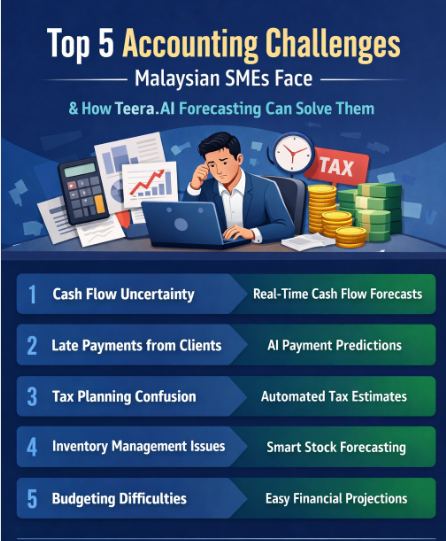
Top 5 Accounting Challenges Malaysian SMEs Face and How Teera.AI Forecasting Can Solve Them
Introdcution
Small and medium enterprises SMEs in Malaysia economic growth. However, many business owners continue to face persistent accounting challenges that affect cash flow, profitability, and long term sustainability.
With increasing competition and evolving financial regulations in Malaysia, relying on traditional accounting methods is no longer enough. Businesses now need smarter tools that provide not just historical data, but also future insights.
This is where AI powered forecasting solutions like Teera.AI come into play, helping SMEs make informed financial decisions with greater accuracy and confidence.
Quick Answer For Featured Snippets
What are the top accounting challenges Malaysian SMEs face?
The most common accounting challenges include cash flow management, manual bookkeeping, lack of financial visibility, poor budgeting, and compliance issues.
How does Teera.AI forecasting help SMEs?
Teera.AI uses AI powered forecasting to predict cash flow, automate financial processes, improve accuracy, and provide real time insights for better decision making.
1. Cash Flow Management Issues
The Problem
Cash flow management remains one of the biggest challenges for SMEs in Malaysia. Many businesses struggle to track payments, manage expenses, and maintain sufficient working capital.
Delayed customer payments and unexpected operational costs often lead to financial strain.
How Teera.AI Forecasting Helps
Teera.AI forecasting analyzes past financial data to predict future cash flow patterns. This allows business owners to:
• Identify potential cash shortages early
• Plan expenses more effectively
• Maintain healthier financial stability
By using predictive insights, SMEs can avoid sudden financial disruptions and manage cash flow proactively.
2. Time Consuming Manual Bookkeeping
The Problem
Many SMEs in Malaysia still rely on spreadsheets or manual accounting methods. This leads to:
• Increased risk of human error
• Time consuming data entry
• Inefficient financial management
Business owners often spend valuable hours on administrative work instead of growing their business.
How Teera.AI Forecasting Helps
Teera.AI automates routine accounting tasks, reducing manual workload significantly. With automation and forecasting combined, businesses can:
• Eliminate repetitive data entry
• Improve accuracy of financial records
• Focus more on strategic growth
This results in higher productivity and better operational efficiency.
3. Lack Of Financial Visibility
The Problem
Without clear financial insights, many SME owners operate without fully understanding their business performance.
They often struggle to answer questions such as:
• Is the business making consistent profit
• Where are the highest expenses
• Can the business afford expansion
How Teera.AI Forecasting Helps
Teera.AI provides real time financial dashboards and predictive analytics, offering:
• Clear overview of income and expenses
• Future revenue projections
• Data driven decision support
This improves financial clarity and enables smarter, faster decision making.
4. Difficulty In Budgeting And Financial Planning
The Problem
Traditional budgeting methods are often static and based only on past data. This makes it difficult for SMEs to adapt to market changes or economic uncertainty in Malaysia.
How Teera.AI Forecasting Helps
Teera.AI uses intelligent forecasting models to:
• Predict future financial scenarios
• Adjust budgets dynamically
• Improve long term planning accuracy
This allows SMEs to build flexible financial strategies that evolve with their business environment.
5. Compliance And Tax Preparation Challenges
The Problem
LHDN Malaysia tax guidelines can be complex for SMEs without dedicated accounting teams.
Common issues include inaccurate reporting, missed deadlines, and difficulties during audits.
How Teera.AI Forecasting Helps
Teera.AI improves financial data accuracy and organization by:
• Maintaining consistent and structured records
• Reducing errors in financial reporting
• Supporting better tax preparation readiness
This helps SMEs stay compliant while reducing stress during tax season.
Why Malaysian SMEs Are Moving Towards AI Accounting
AI adoption in Malaysia is growing rapidly, especially among SMEs looking to improve efficiency and competitiveness.
Teera.AI forecasting stands out by combining automation with predictive intelligence, enabling businesses to:
• Make proactive financial decisions
• Reduce operational risks
• Save time and resources
• Improve overall business performance
Benefits Of Teera.AI Forecasting For Malaysian SMEs
Teera.AI is designed specifically with SMEs in mind, offering:
• AI powered cash flow forecasting
• Real time financial insights
• Automated bookkeeping support
• Scalable solutions for growing businesses
This makes it an ideal choice for SMEs aiming to modernize their accounting processes.
Conclusion
Accounting challenges are a common hurdle for SMEs in Malaysia, but they can be effectively managed with the right tools.
By leveraging AI powered forecasting through Teera.AI, businesses can transform their financial management from reactive to proactive.
In today’s competitive landscape, adopting smarter accounting solutions is no longer optional. It is essential for sustainable growth and long term success.
Understanding LHDN’S E-Invoice Requirement ?
The implementation of e-Invoicing by the Inland Revenue Board of Malaysia (LHDN) marks one of the most significant changes to financial reporting and tax compliance in recent years. While many businesses view e-Invoicing as a technology initiative, accountants should recognize that it is fundamentally a compliance and data governance requirement that directly affects accounting processes, documentation, and audit readiness.
Why E-Invoicing Matters to Accountants
Traditionally, businesses could issue invoices independently and maintain supporting records for future tax audits. Under the e-Invoice framework, transaction data is submitted to LHDN in near real-time, allowing tax authorities to validate and cross-reference business transactions electronically.
This shift means that accountants must place greater emphasis on the accuracy, completeness, and consistency of accounting records before invoices are issued. Errors that were previously identified during month-end reviews or annual audits may now be detected much earlier through the e-Invoice validation process.
Impact on Accounting Operations
The introduction of e-Invoicing affects several core accounting functions:
Revenue Recognition
Sales invoices submitted through the MyInvois platform become part of LHDN’s transaction database. Accountants must ensure that invoice dates, customer information, tax treatment, and transaction values accurately reflect the underlying business activity and align with revenue recognition policies.
Accounts Receivable Management
Customer details, including Tax Identification Numbers (TIN) and registration information, must be maintained accurately. Incomplete or incorrect customer master data can result in rejected e-Invoices and delays in collections.
Accounts Payable Processing
Businesses should verify supplier-issued e-Invoices before recording purchases and claiming deductible expenses. Proper validation of supplier information and invoice status becomes increasingly important for maintaining compliant accounting records.
Credit Notes and Debit Notes
Adjustments to previously issued invoices can no longer be treated as simple accounting entries. Credit notes and debit notes must follow LHDN’s prescribed e-Invoice process, requiring appropriate supporting documentation and proper linkage to the original invoice.
Audit Trail and Documentation
One of the key benefits of e-Invoicing is the creation of a stronger audit trail. Every validated invoice is assigned a unique identifier and validation record, making transaction verification more efficient during internal audits, external audits, and tax audits.
Data Quality Becomes Critical
For many organizations, the greatest challenge is not the submission of e-Invoices but ensuring the quality of the underlying accounting data.
Accountants should review:
- Customer master records
- Supplier master records
- Tax codes and classifications
- Product and service descriptions
- Currency settings
- General ledger mappings
- Credit note and debit note procedures
Poor data quality can result in invoice rejections, compliance issues, and operational disruptions.
Internal Controls and Compliance
The e-Invoice environment increases the importance of internal controls. Organizations should establish procedures for:
- Customer onboarding and TIN verification
- Invoice approval workflows
- Tax code maintenance
- Credit and debit note authorization
- Exception handling for rejected invoices
- Reconciliation between accounting records and MyInvois submissions
Regular reconciliation should be performed to ensure that accounting records match the validated transactions maintained by LHDN.
System Readiness
Accountants should work closely with software providers and IT teams to ensure that accounting systems are capable of:
- Generating compliant e-Invoice data
- Submitting invoices through MyInvois APIs
- Managing invoice validation statuses
- Handling credit notes and debit notes
- Storing validation references and QR codes
- Supporting audit and reconciliation requirements
Organizations that rely heavily on manual invoicing processes may need to redesign workflows to accommodate the new requirements.
Key Considerations for Accountants
As e-Invoicing becomes mandatory, accountants should focus on three key areas:
Accuracy – Ensure transaction data is correct before submission.
Compliance – Understand LHDN requirements for invoices, credit notes, debit notes, and self-billed documents.
Control – Strengthen internal processes to maintain reliable financial records and support audit requirements.
Conclusion
LHDN’s e-Invoice initiative is more than a digital invoicing requirement—it represents a transformation in how transaction data is reported, monitored, and audited. Accountants play a critical role in ensuring that financial records remain accurate, compliant, and aligned with regulatory expectations. Organizations that proactively prepare their accounting processes, data governance, and internal controls will be better positioned to meet compliance requirements while improving operational efficiency.